Look at any shelf of handheld electronic games from the 1970s and early 80s and you will see three very different kinds of screen. Each one shaped how the games looked, how they played, how many batteries they ate and how they have survived the decades since. Here is a short guide to all three.
LED: red dots in the dark
The first wave of handheld games ran on light-emitting diodes, the same red dots that lit up digital clocks and calculators. A handful of LEDs could stand in for a racing car, a footballer or a boxer, and players filled in the rest with their imagination. Mattel’s Auto Race of 1976 turned a few red dots into a motorway; Coleco’s Head to Head Boxing built two fighters out of red LED shapes seen from above, with arms that flick out to punch.
LED games were simple to read and ran happily on a single 9V battery, but there was only so much detail a grid of dots could show. Some makers did without a screen altogether: Milton Bradley’s Simon uses nothing but four coloured lenses and four tones.
VFD: the glow at its brightest
Vacuum fluorescent displays were the technology that gives this book its name. Like LEDs, VFD tubes had been used in pocket calculators, but they could glow in several colours at once. Every alien, frog or pellet is a fixed shape printed onto the display and simply switched on and off, so nothing can ever overlap. Coloured filters and a magnifying lens do the rest.
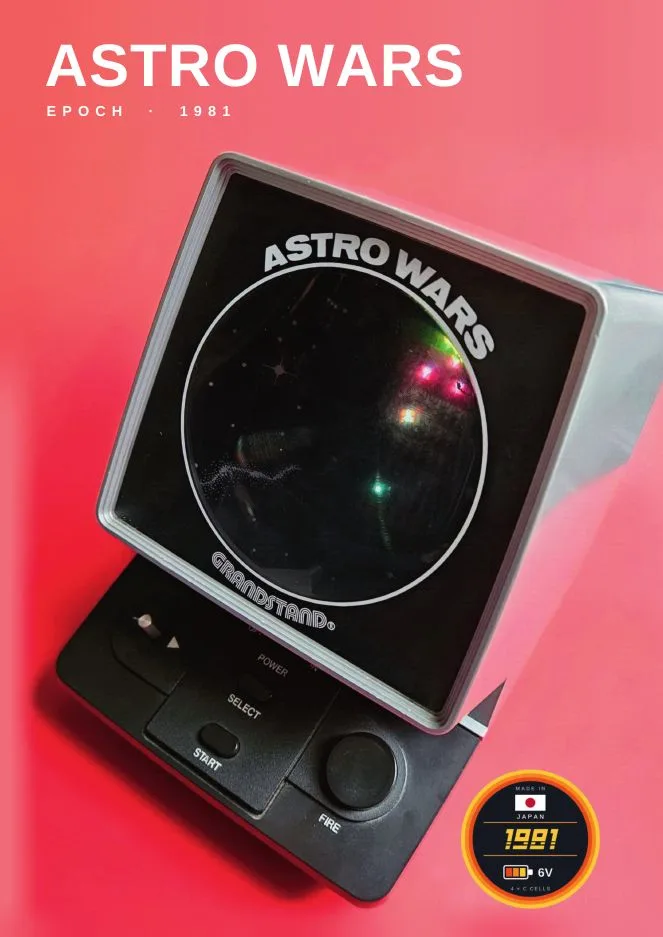
By 1981 VFD games were at their peak. Epoch’s Astro Wars, sold in Britain by Grandstand, became one of the defining, and best-selling, tabletop games of the year there. Bandai badged its range “FL”, short for fluorescent, on games such as Crazy Climbing, and Coleco squeezed Pac-Man, Galaxian, Frogger and Donkey Kong into miniature arcade cabinets.
The catch was power. A VFD tube needs far more electricity than an LCD; a teardown of one Entex game found the screen being driven at about 39 volts. That is why most VFD tabletops ask for four C or even D batteries, and why so many have battery compartments that need checking for old corrosion today.
LCD: the quiet revolution
Liquid crystal displays arrived as modest grey shapes, but they changed everything. They used so little power that a game could run on two button cells, and they were thin enough to slip into a shirt pocket. Nintendo’s Game & Watch appeared in 1980, and pocket games such as Grandstand’s Mini Munchman and Crazy Kong doubled as clocks, alarms and stopwatches.
LCD games work like VFD ones in one respect: every pose of every character is a fixed shape built into the glass. Tilt an LCD screen to the light and you can sometimes see them all waiting. Unlike LEDs or VFDs, though, an LCD makes no light of its own. Tomy’s Thundering Turbo lights its twin screens with daylight through a window on top, so the racing is only as bright as the room you play in.
By 1985 LCD had taken over, and the handheld was being reborn as something leaner, on the road that led to the Game Boy.
What it means for collectors
- LED games are usually robust. Check for dim or dead segments, and a corroded 9V clip.
- VFD games are the showpieces. Fit fresh batteries before judging one, as weak cells can make the screen dim or behave oddly, and look for faded filters and a worn finish.
- LCD games are small and efficient, but screens can suffer from dark patches or “bleeding”, and button cells left in place can leak.
Every game in The Glow of the Game lists its display type alongside its maker, year, country and power, and the second volume ends with a glossary of LED, VFD and LCD terms. You can browse every game in both books on The Games page.