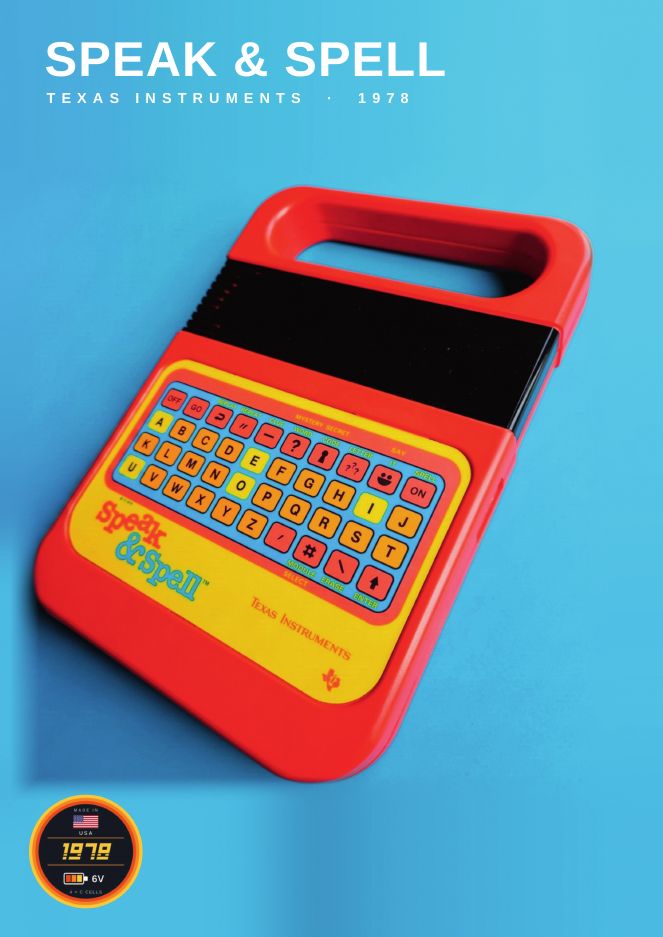
Listen to the synthesised voice say a word, spell it out on the alphabetical keyboard and see how many you get right out of ten: Speak & Spell is the talking tutor that put a speech synthesiser in a child’s hands.
Earlier talking toys relied on tapes or tiny records. Speak & Spell has no moving parts: its words are stored on chips and shown, letter by letter, on a glowing vacuum fluorescent display (VFD). The front is marked © TI-1978; this flat membrane keyboard replaced the first version’s raised buttons in 1980.
Interesting facts
E.T. phone home. In Steven Spielberg’s E.T. the Extra-Terrestrial (1982) the stranded alien wires a Speak & Spell to a saw blade, a coat hanger, a coffee can and a foil-lined umbrella to call his ship. TI followed up with an official E.T. Fantasy module of film-themed words to spell.
Bent out of shape. Open the case, bridge the right points on the circuit board, and the patient teacher’s voice dissolves into glitchy robot babble. Circuit-bending pioneer Reed Ghazala built his “Incantor” instruments from Speak & Spells, still a favourite of experimental musicians.
The first chip that talked. Paul Breedlove’s team at TI began work in 1976 with a budget of just $25,000. Unveiled at the Consumer Electronics Show in June 1978 at $50, their toy used the first single-chip speech synthesiser. In 2009 the IEEE named it an engineering Milestone.